A short-term loan can feel like a simple solution when money is urgently needed. You may have an EMI due, a medical expense, rent to pay, or a temporary gap in your income. Borrowing a small amount can appear easier than facing an immediate financial problem.
The trouble begins when one loan is used to repay another, and that results in a Payday loan trap
The borrower takes a new loan to cover an old payment, then another loan to manage the next repayment. What started as temporary borrowing can slowly become a cycle of debt.
A payday loan trap can become particularly difficult when the borrower has limited income and relies on each new loan to meet the previous repayment.
This situation is commonly described as a payday loan trap. The same pattern can also occur with certain short-term, high-cost, digital or app-based loans. The name of the loan matters less than the underlying problem: borrowing repeatedly because there is not enough income or cash flow to meet existing obligations.
If you are already caught in this cycle, the answer is usually not to keep borrowing. The first step is to understand exactly how much you owe, stop making the problem larger, and create a realistic plan for dealing with your lenders.
What Is a Payday Loan Trap?
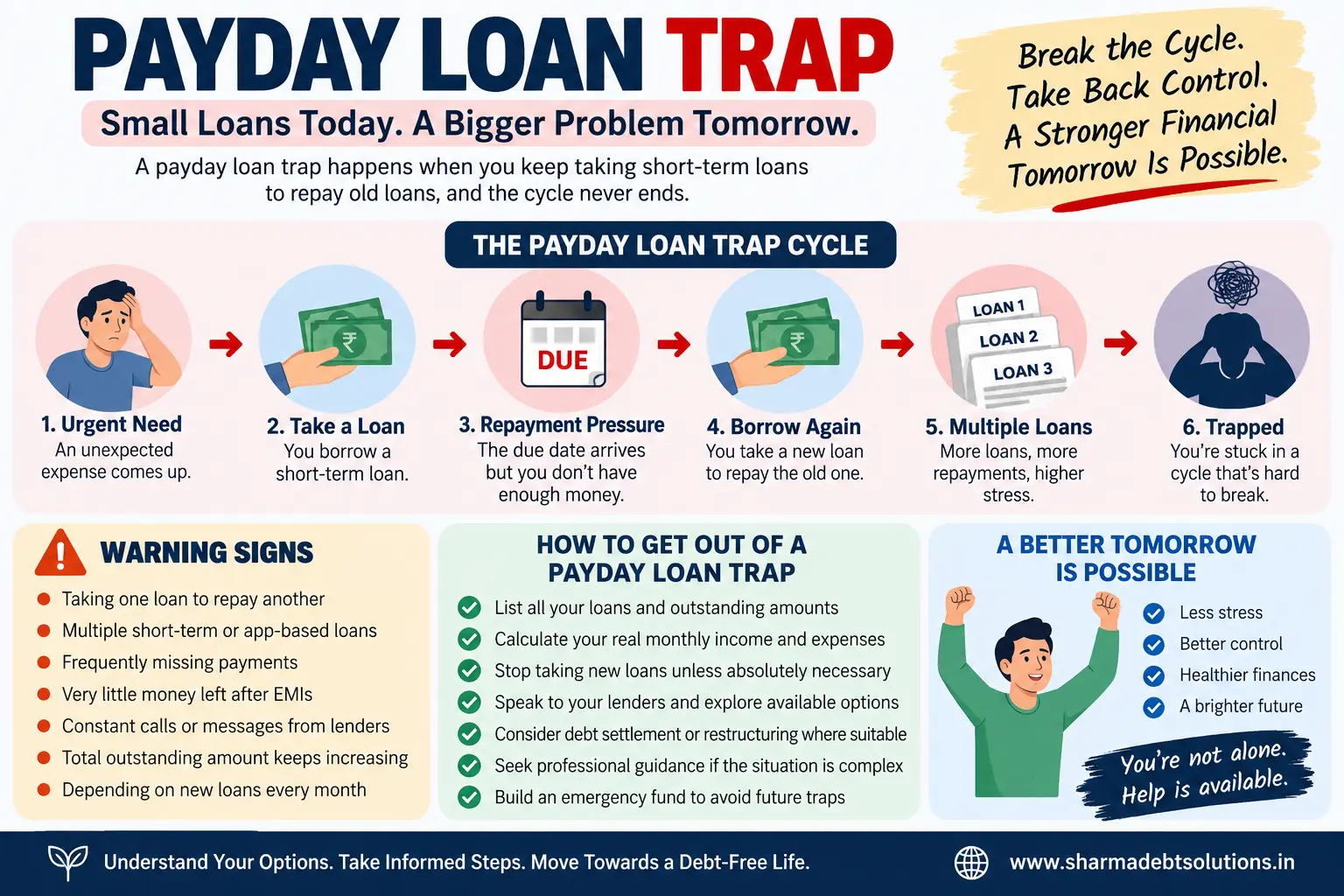
A payday loan trap occurs when a borrower repeatedly takes short-term credit because they cannot comfortably repay their existing debt from their normal income.
Imagine that you have an urgent expense of ₹10,000. You borrow the money and agree to repay it shortly afterward. When the repayment date arrives, you still do not have enough money. Instead of being able to clear the loan, you borrow another ₹10,000.
Now you have a second obligation.
The following month, the same problem happens again. You take another loan, use part of your income to make repayments, and find yourself short of money for ordinary expenses. Eventually, borrowing becomes part of your monthly survival strategy.
That is the dangerous point.
A loan is supposed to solve a temporary cash-flow problem. A debt trap develops when the loan itself becomes the reason you need another loan.
How Does a Payday Loan Trap Develop?
The cycle often develops gradually rather than through one large financial mistake.
The earlier you recognize a payday loan trap, the more choices you may have for dealing with the underlying debt.
A typical pattern can look like this:
Emergency expense → short-term loan → repayment pressure → new borrowing → multiple repayments → shortage of cash → further borrowing
The borrower may initially believe:
“I only need this loan for a few weeks.”
But when the repayment arrives, the underlying financial situation may not have changed.
If income remains the same and expenses remain high, there is no additional money available to repay the debt. Borrowing again only postpones the problem.
This is why repeatedly taking new credit should be treated as a warning sign.
Other warning signs include:
- Taking one loan to repay another
- Using one credit card to pay another card
- Applying for several loans within a short period
- Missing EMIs and then borrowing to catch up
- Having very little money left after debt repayments
- Receiving frequent calls or messages about overdue payments
- Paying debt but seeing the total outstanding amount remain high
- Depending on short-term loans every month
- Hiding the extent of your borrowing from family members
If several of these situations apply to you, it may be time to stop looking for another loan and start looking for a debt-exit strategy.
Not sure what to do next?
Discuss your Payday debt situation and understand the options available to you.
Chat on WhatsApp*Paid Support Only*
Why Short-Term Borrowing Can Become Difficult to Manage
Short-term borrowing can create intense repayment pressure because the repayment period may be much shorter than the period needed for the borrower’s finances to recover.
Suppose your monthly income is ₹40,000 and your essential expenses are ₹30,000. You have ₹10,000 available after basic expenses.
If several loan repayments together require ₹15,000, there is already a ₹5,000 monthly gap.
Taking another small loan may temporarily fill that gap. But next month, the new loan creates another repayment.
The borrower is effectively using future income to solve today’s shortage.
This is the central problem behind many debt cycles.
The issue isn’t simply that the borrower has debt. The issue is that the monthly cash flow is no longer sufficient to service the debt comfortably.
In a payday loan trap, this cash-flow gap can cause the borrower to depend on another short-term loan simply to reach the next payday.
Payday Loan Trap: What Should You Do First?
If you believe you are caught in a payday loan trap, don’t immediately apply for another loan.
Breaking a payday loan trap starts with understanding the full amount you owe rather than focusing only on the next payment.
First, stop and calculate.
Make a complete list of every outstanding obligation:
| Information | What to record |
|---|---|
| Lender | Bank, NBFC or lending platform |
| Loan type | Personal, short-term, digital, credit card, etc. |
| Outstanding amount | Current amount payable |
| EMI/payment | Regular repayment amount |
| Due date | Next payment date |
| Overdue amount | Any unpaid amount |
| Interest/charges | As shown in your loan documents |
| Status | Current, overdue or otherwise outstanding |
Don’t rely on memory.
If you have five or six loans, you may remember the approximate amount but forget charges, due dates or outstanding balances. Put everything in one place.
Once you can see the complete picture, you can start making decisions based on facts rather than panic.
Stop Using New Debt to Hide Old Debt
One of the most important steps is to stop increasing your total borrowing unless there is a genuinely necessary and carefully evaluated reason.
This can be difficult because another loan can provide immediate relief.
For example:
“I’ll take ₹20,000 today and worry about repayment next month.”
But if next month’s income is already committed to existing EMIs, the new loan hasn’t solved the underlying problem.
It has simply moved the problem forward.
This doesn’t mean every form of refinancing or consolidation is bad. The goal is to stop the payday loan trap from becoming a permanent cycle of borrowing and repayment. In some circumstances, restructuring debt can make financial sense. But taking another expensive short-term loan simply because an existing payment is due can deepen the cycle.
Before borrowing again, ask:
“Where will the money to repay this new loan actually come from?”
If the honest answer is “another loan,” that’s a serious warning sign.
Create a Realistic Debt Repayment Plan
Once you know what you owe, calculate how much money is genuinely available for debt repayment each month.
Start with your monthly take-home income.
Then subtract essential expenses such as:
- Food
- Rent or housing
- Utilities
- Transportation
- Education
- Necessary medical expenses
- Basic household requirements
The amount left over is your actual capacity for debt repayment.
Don’t create a repayment plan that looks good on paper but leaves you without enough money for basic living expenses.
A sustainable plan is more useful than an aggressive plan that collapses after two weeks.
If your total scheduled repayments are substantially higher than what you can realistically afford, you may need to explore alternatives rather than simply trying harder to make impossible payments.
Speak to Your Lenders Instead of Avoiding Them
When borrowers become overwhelmed, they sometimes stop opening messages and avoid calls completely.
Ignoring the situation usually doesn’t make the underlying debt disappear.
Where appropriate, communicate with the lender and understand the available options. Depending on the lender and the circumstances, there may be different ways to address overdue obligations.
Keep communication factual and documented.
If you cannot make a payment, don’t promise an amount or date that you know you cannot realistically meet.
It is better to communicate your actual financial position than repeatedly make promises that cannot be kept.
Consider Whether Debt Settlement Is Appropriate
For some borrowers who are genuinely unable to repay their outstanding debt in full, loan settlement may be one option worth understanding.
Debt settlement generally involves negotiating with a lender to resolve an outstanding debt for an agreed amount, subject to the lender’s acceptance and the specific circumstances.
However, settlement is not the right answer for everyone.
It can have consequences for your credit history and future access to credit. The exact implications depend on the circumstances and the lender’s reporting.
Therefore, settlement should not be treated as a magic way to erase debt.
It should be considered only after looking at your overall financial position and understanding the consequences.
Don’t Ignore the Difference Between Being Late and Being Unable to Repay
There is a major difference between:
“I can pay, but I will be a few days late.”
and:
“Even if I use my entire disposable income, I cannot repay my loans.”
The first may be a temporary cash-flow problem.
The second can indicate structural over-indebtedness.
If your income is consistently insufficient to cover your debt obligations, repeatedly paying one account by borrowing from another is unlikely to provide a permanent solution.
You need to address the underlying mismatch between income, essential expenses and total debt obligations.
Be Careful With “Instant Debt Relief” Promises
When people are desperate, they become vulnerable to unrealistic promises.
Be cautious about anyone who guarantees:
- Complete loan waiver
- Immediate removal of all debt
- Guaranteed settlement
- Guaranteed improvement in credit score
- Guaranteed cancellation of legal proceedings
- Guaranteed results without reviewing your documents
Debt problems are individual. No genuine consultant can responsibly guarantee a particular outcome without understanding the lender, the loan documents, the outstanding amount, and the circumstances.
Borrowers should also be familiar with the safeguards and information provided by the Reserve Bank of India (RBI) regarding digital lending and regulated lending entities.
Before paying anyone for assistance, understand exactly what service they are providing and what they can and cannot do.
Payday Loan Trap Help: When Should You Seek Assistance?
If you have one manageable loan and enough income to repay it, you may simply need better budgeting.
If a payday loan trap involves several lenders or repeated missed payments, getting an objective view of the entire debt situation can help you understand your options.
But professional assistance may become useful when the situation is more complicated—for example, when you have multiple lenders, several overdue accounts, repeated collection activity, or no realistic ability to clear the entire debt from your available income.
The purpose of getting help should be to understand your options and organise the situation—not to hand over responsibility blindly.
A good review should begin with your actual numbers:
How much do you owe?
How many lenders are involved?
How much can you realistically afford?
Which accounts are overdue?
What options are available?
Only after answering those questions should you decide what to do next.
What If You Already Have Several Short-Term Loans?
Don’t panic and don’t start taking additional loans simply because you have several repayment dates approaching.
If multiple short-term loans are already competing for the same monthly income, you may be dealing with a payday loan trap rather than a temporary cash-flow problem.
Instead, create a complete debt map.
For every loan, record:
- Current outstanding amount
- Monthly payment
- Due date
- Number of missed payments, if any
- Lender
- Any communication received
- Your available monthly repayment capacity
Then prioritise the situation logically.
If you have several different debts, the best strategy depends on the type of debt, your financial capacity, the contractual terms and the status of each account.
There is no universal “pay this loan first” rule that works for every borrower.
How to Prevent Another Debt Trap
Getting out of debt is only half the job.
The bigger goal is to avoid returning to the same cycle.
Once your situation becomes stable, try to build an emergency reserve, even if you can initially save only a small amount.
Review recurring expenses.
Avoid taking new credit simply to maintain a lifestyle that your current income cannot support.
And most importantly, don’t treat borrowing as a solution to every temporary shortage of cash.
If an unexpected ₹10,000 expense repeatedly causes you to borrow ₹10,000, ₹20,000 or ₹30,000, the long-term solution is to build financial resilience rather than continuously increase borrowing.
Frequently Asked Questions (FAQs)
What is a payday loan trap?
A payday loan trap is a cycle where a borrower repeatedly takes new short-term loans because they cannot comfortably repay existing debt. Instead of reducing the total debt, new borrowing is used to manage previous repayments.
How do I get out of a payday loan trap?
Start by stopping unnecessary new borrowing and listing all your outstanding loans, repayments and due dates. Calculate what you can realistically afford each month and then consider appropriate options such as repayment arrangements, restructuring or settlement, depending on your circumstances.
What should I do if I cannot pay my payday loan?
If you cannot make the payment, first understand the amount outstanding and any applicable charges. Contact the lender through its official channels and explain your situation rather than taking another expensive loan simply to make the current payment.
Can I settle a payday loan?
Settlement may be possible in some circumstances, but it depends on the lender, the account status and your financial situation. A borrower should understand the financial and credit-history consequences before agreeing to a settlement.
Is taking another loan to repay a payday loan a good idea?
Usually, repeatedly borrowing to repay existing short-term debt can make the situation worse. Before taking another loan, work out whether your normal income will actually be sufficient to repay the new borrowing as well as your existing obligations.
What is a payday loan debt trap?
A payday loan debt trap is essentially a situation in which short-term borrowing becomes a continuing cycle of debt. The borrower may keep taking new credit because their available income is insufficient to clear their existing obligations.
Can a debt consultant help me with a payday loan trap?
A debt consultant can help you understand and organise your debt situation and discuss possible resolution strategies. However, no consultant can responsibly guarantee that a lender will accept a particular repayment or settlement proposal.
Will settling a loan affect my credit history?
A settlement can have an impact on your credit history and may affect your ability to obtain credit in the future. Before choosing settlement, understand how the account is expected to be reported and consider whether you have other viable repayment options.
Final Thoughts
A payday loan trap rarely begins with the intention of getting deeply into debt. It often begins with a small emergency and the belief that the problem will be solved when the next salary arrives.
Sometimes it is.
But when the next salary is already committed to existing repayments, another loan becomes necessary. Then another. Eventually, the borrower is working mainly to keep up with previous borrowing.
The way out begins when you stop adding new debt and look at the complete financial picture.
List every loan. Calculate what you genuinely owe. Work out what you can realistically afford. Communicate appropriately with lenders. And if your debt is beyond your repayment capacity, investigate the available options—including whether restructuring, negotiation or settlement may be appropriate in your circumstances.
Being in a debt trap does not mean you have to remain there. But getting out usually requires facing the numbers honestly rather than borrowing your way through the next due date.