If you have missed an EMI because there was not enough money in your bank account, you may notice repeated attempts by the lender to collect the payment automatically.
This often leads to an important question: How Many Times Can a Lender Attempt Auto-Debit in One Day?
The short answer is that there is no general RBI rule prescribing one fixed number of auto-debit attempts that every lender can make in a day. Therefore, seeing two, three or even five attempted transactions does not, by itself, establish that the lender has violated an RBI rule.
However, that does not mean every auto-debit attempt is automatically valid. The relevant NACH or ECS mandate, the amount being presented, the transaction status, the reason for failure, and whether the mandate was still active all matter.
This guide explains how many times a lender can attempt auto-debit in one day, what NACH and ECS mandates mean, what happens after a failed EMI debit, and what you can do if repeated attempts are affecting your bank account.
Important: This article is for general educational purposes. It is based on publicly available RBI and NPCI material and is not legal advice. The applicable position can depend on your loan agreement, mandate, bank, lender and individual circumstances.
Quick Answer: How Many Times Can a Lender Attempt Auto-Debit in One Day?
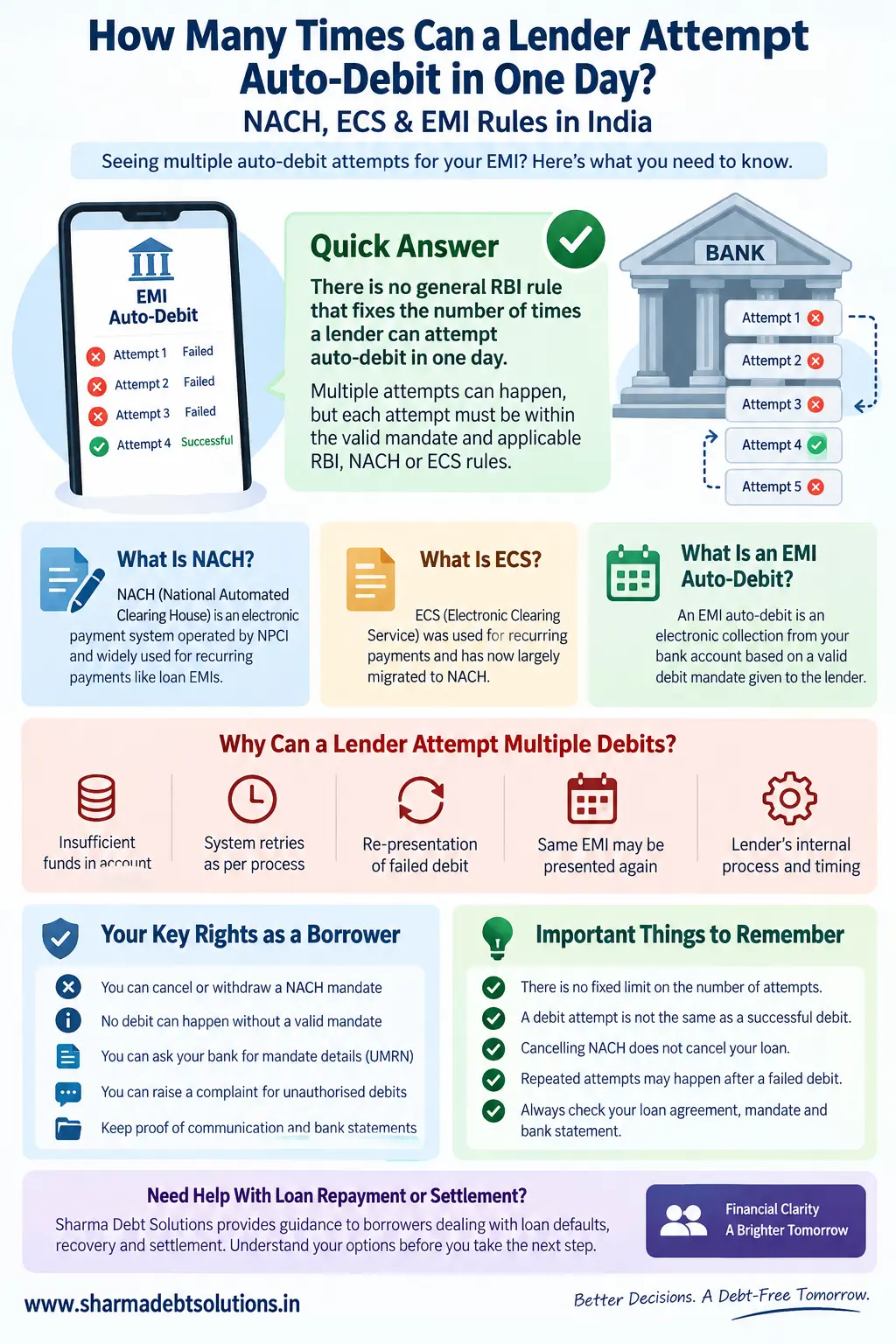
If you are specifically searching for how many times can a lender attempt auto-debit in one day, here is the practical answer:
| Question | Answer |
|---|---|
| Is there a universal RBI limit on daily EMI auto-debit attempts? | No |
| Are five attempts automatically illegal? | No |
| Can a failed EMI debit be presented again? | Potentially, depending on the applicable process |
| Can a borrower withdraw a NACH mandate? | Yes, subject to the applicable process |
| Does cancelling NACH cancel the loan? | No |
| Should repeated debit attempts be documented? | Yes |
The number of attempts alone does not determine whether a lender’s activity was proper.
If you see repeated attempts, look at the mandate, transaction status, amount, return reason and timing before reaching a conclusion.
How Many Times Can a Lender Attempt Auto-Debit in One Day Under RBI Rules?
There is no general RBI rule that says a lender may attempt an EMI auto-debit only once, twice or five times in a day.
This is an important distinction because borrowers sometimes see claims online that a certain number of attempts is automatically illegal.
The RBI’s ECS framework deals with electronic debit mandates, returned transactions and situations involving multiple debits. It does not establish one universal numerical limit applicable to every lender and every EMI auto-debit situation.
So, if you are asking how many times can a lender attempt auto-debit in one day, the answer cannot simply be a number.
The more useful questions are:
- Was there a valid mandate?
- Was the mandate still active?
- Was the debit amount within the authorised amount?
- Did the transaction actually succeed?
- Why was the transaction returned?
- Was the same EMI being presented again?
- Had the borrower already withdrawn the mandate?
- Were any charges imposed?
Those facts are more important than simply counting the attempts.
Feeling trapped by your loans?
If your EMIs, overdue loans or recovery pressure have become difficult to manage, speak with Sharma Debt Solutions about your situation in a personalised, one-on-one paid consultation.
Book a Personalised ConsultationPaid one-on-one consultation · Confidential · Complete clarity
Can a Lender Attempt Auto-Debit 5 Times in One Day?
If you are asking, “Can a lender attempt auto-debit 5 times in one day?”, the answer is: five attempts are not automatically illegal simply because there are five.
There is no general RBI provision stating that exactly five auto-debit attempts in one day are automatically permitted or automatically prohibited.
RBI’s ECS guidance specifically addresses situations involving multiple debits to the same beneficiary on the same day and requires appropriate care and information so that the account holder can identify the purpose of the debit.
Therefore, if your bank statement shows five attempts, you should find out what those five entries actually represent.
For example:
- Were all five transactions rejected?
- Was one transaction successful?
- Were the transactions for the same EMI?
- Were they presented under the same mandate?
- What was the return reason?
- Was the mandate active at the time?
A statement showing five attempted transactions is very different from five successful debits.
What if all five attempts failed because of insufficient funds?
Five failed auto-debit attempts in one day are not automatically prohibited by an RBI rule.
However, if repeated presentations or related bank charges resulted in an account being debited or pushed substantially negative, the transactions should be examined individually.
The borrower should obtain the transaction records, mandate details, return reasons and charges from the bank and lender rather than assuming that all five attempts were permissible.
This distinction is particularly important when a borrower sees a large negative balance after repeated EMI debit activity.
What Does NACH Auto-Debit Mean for an EMI?
NACH stands for National Automated Clearing House.
It is operated by the National Payments Corporation of India (NPCI) and is widely used for recurring payments, including loan EMIs, insurance premiums and other regular collections.
When you give a lender a NACH debit mandate, you authorise electronic collection from your bank account according to the terms of that mandate.
A NACH mandate can contain information such as:
- the bank account to be debited;
- the amount or maximum amount;
- start date;
- end date or validity;
- lender or user institution details; and
- other mandate information.
NPCI’s NACH procedural guidelines provide for validation of debit transactions against the relevant mandate information.
This is important because an outstanding loan does not mean that a lender has unlimited authority to submit any debit instruction it chooses.
You can refer to the NPCI NACH procedural guidelines for the payment-system framework governing NACH transactions and return reasons.
What Is the Difference Between NACH, ECS and EMI Auto-Debit?
Borrowers often use NACH, ECS and auto-debit interchangeably, but they refer to related yet different concepts.
NACH
NACH is the nationwide electronic clearing system operated by NPCI and is widely used for recurring debit collections.
ECS
ECS stands for Electronic Clearing Service. It was an electronic clearing mechanism used for recurring payments before much of the system migrated to NACH.
RBI has explained that ECS centres migrated to NACH, with the migration completed by January 2020.
EMI auto-debit
This is the practical term borrowers use when their lender automatically attempts to collect a scheduled EMI from their bank account.
Debit mandate
A debit mandate is the authorisation under which the account holder permits a lender or other institution to collect money electronically, subject to the applicable terms.
UMRN
UMRN stands for Unique Mandate Reference Number.
If you are investigating repeated NACH debit attempts, your bank may be able to provide the relevant mandate information and UMRN.
What Happens When an EMI Auto-Debit Fails Because of Insufficient Funds?
Suppose your EMI is ₹20,000 but only ₹3,000 is available in your bank account.
The lender may present an EMI auto-debit, but the transaction can be returned because of insufficient funds.
The failed transaction does not cancel the EMI.
Depending on the lender’s collection process and the applicable payment-system procedures, the lender may subsequently present the unpaid amount again or use another permitted collection method.
This is one reason a borrower may see repeated auto-debit attempts.
But remember:
A debit attempt is not necessarily a successful debit.
Your bank statement may show entries such as:
- NACH debit;
- ACH debit;
- ECS debit;
- NACH return;
- insufficient funds;
- return charges; or
- another bank-specific transaction description.
Always check the actual transaction status.
Can a Lender Retry a Failed NACH or ECS Debit?
A failed or returned EMI auto-debit does not necessarily mean that the lender can never attempt collection again.
Payment-system procedures provide for returned transactions and, in appropriate circumstances, re-presentation.
However, this does not mean a lender has unlimited permission to repeatedly present transactions without regard to the applicable mandate and payment-system requirements.
RBI’s ECS framework addresses returned items, re-presentation and multiple debits to the same beneficiary on the same day.
Therefore, if you are trying to determine how many times can a lender attempt auto-debit in one day, you should examine the individual transactions rather than assuming that a particular number is automatically allowed.
Debit Attempt vs Successful Debit: What Is the Difference?
This distinction matters considerably when dealing with repeated EMI auto-debit attempts.
Debit attempt
The lender or payment system presents an instruction asking the bank to debit your account.
Failed or returned debit
The requested transaction is not successfully completed and is returned for a reason such as insufficient funds.
Successful debit
The money actually leaves your bank account.
For example, suppose your statement contains five NACH-related entries.
If four were returned because of insufficient funds and one was successfully processed, it would be inaccurate to say that the lender successfully debited your account five times.
On the other hand, if the same amount was actually deducted multiple times, you should investigate the matter immediately.
What Does RBI Say About a Valid NACH or ECS Mandate?
The validity of the debit mandate is one of the most important issues when assessing an auto-debit transaction.
RBI’s ECS guidance states that a customer’s account should be debited on the basis of an appropriate mandate. It also addresses situations where there is no valid mandate and the withdrawal of an existing mandate.
RBI has also provided that a customer can withdraw a mandate and that withdrawal instructions are to be treated similarly to a stop-payment instruction.
This means borrowers should keep proof of any mandate cancellation or withdrawal.
For the underlying RBI guidance on ECS debit mandates, withdrawal of mandates and the safeguards applicable to electronic debits, refer to the Reserve Bank of India’s ECS mandate guidelines.
Can You Cancel or Withdraw a NACH Mandate?
Yes. There are mechanisms for withdrawing or cancelling a NACH or other electronic debit mandate.
RBI’s ECS guidance recognises the account holder’s ability to withdraw a mandate through the bank without requiring prior approval from the beneficiary institution.
The exact procedure can vary between banks and payment arrangements.
If you want to withdraw a NACH mandate:
- Contact your bank.
- Identify the relevant NACH mandate.
- Ask how it can be withdrawn or cancelled.
- Obtain written acknowledgement or confirmation.
- Inform the lender as well.
- Keep copies of your communications.
Cancelling NACH does not cancel your loan
This is extremely important.
Cancelling a NACH mandate does not cancel the underlying loan or EMI obligation.
It changes the automatic payment mechanism.
If money remains due under your loan agreement, the lender may still pursue repayment through other lawful means.
Therefore, do not treat NACH cancellation as a solution to the underlying debt.
What If a Lender Attempts Auto-Debit After You Cancelled the Mandate?
If a lender attempts to debit your account after you have validly withdrawn a mandate, document the situation carefully.
Keep:
- the cancellation request;
- bank acknowledgement;
- email or SMS confirmation;
- UMRN or mandate details;
- bank statements;
- transaction reference numbers;
- screenshots; and
- correspondence with the lender.
RBI’s ECS guidance contains protections concerning withdrawn mandates, while NPCI’s NACH procedures also contain provisions concerning transactions involving revoked mandates and applicable payment-system requirements.
If this occurs, raise the issue with your bank and lender in writing.
What If Repeated Auto-Debit Attempts Put Your Bank Account Into Negative Balance?
A repeated debit attempt and an actual negative bank balance are two different issues.
Whether a bank permits an account to go negative can depend on the type of account, the bank’s arrangements and the way the transaction is processed.
If your account has gone into negative balance, identify exactly what caused it.
Check:
- whether the debit was successful;
- which transaction created the negative balance;
- whether an overdraft or other facility was involved;
- whether bank charges were added;
- whether multiple transactions actually settled; and
- whether the final account statement matches what appeared in your banking app.
Do not assume that every failed NACH attempt automatically creates a negative balance.
If repeated lender debit attempts are contributing to the problem, preserve the statement and raise a written complaint with the bank and lender where appropriate.
If repeated lender debit attempts have caused your bank account to go into a negative balance, see our detailed guide on RBI guidelines for a negative balance bank account for a more detailed explanation.
Can a Lender Charge You for a Failed EMI Auto-Debit?
A failed EMI auto-debit may result in charges depending on the applicable loan terms, lender policies and bank charges.
Before accepting or disputing a charge, check:
- loan agreement;
- Key Fact Statement, where applicable;
- schedule of charges;
- NACH mandate terms;
- lender communication; and
- bank statement.
If you believe a charge is incorrect, ask the lender or bank to explain the basis for the charge in writing.
Do not assume every bounce charge is automatically illegal, but also do not assume every charge is automatically correct.
The underlying documents matter.
What Should You Do If a Lender Keeps Attempting Auto-Debit?
If you are seeing repeated EMI auto-debit attempts, take a structured approach.
1. Download your bank statement
Get the complete statement covering the relevant period.
Do not rely only on a screenshot showing your available balance.
2. Identify every auto-debit transaction
Record:
- date;
- time, if available;
- amount;
- transaction narration;
- transaction reference;
- status; and
- return reason.
For example:
| Date | Time | Amount | Narration | Status |
|---|---|---|---|---|
| 11 Sept | 8:12 AM | ₹15,000 | NACH – Lender | Returned |
| 11 Sept | 11:34 AM | ₹15,000 | NACH – Lender | Returned |
| 11 Sept | 3:18 PM | ₹15,000 | NACH – Lender | Returned |
This is only an illustration. Your bank’s narration and transaction status may be different.
3. Identify the NACH mandate
Ask your bank for the relevant mandate information and UMRN, where available.
Check:
- lender name;
- mandate status;
- authorised amount;
- validity; and
- whether the mandate is active or cancelled.
4. Ask the lender for an explanation
Ask the lender to confirm:
- why the EMI was presented;
- how many times it was presented;
- whether each presentation related to the same EMI;
- the reason for each failed transaction;
- the relevant mandate reference; and
- any charges applied.
5. Contact your bank if you believe the debit was improper
If you believe the transaction was outside the mandate, occurred after valid cancellation, or was otherwise unauthorised, raise a written complaint with the bank.
6. Keep everything in writing
Emails, complaint numbers, statements and acknowledgements are much more useful later than relying only on telephone conversations.
Can Multiple Lenders Attempt Auto-Debit From the Same Bank Account?
Yes. A borrower can have multiple active electronic debit mandates linked to the same bank account.
For example, someone may have:
- a personal-loan EMI;
- a vehicle-loan EMI;
- a credit-card payment arrangement;
- an insurance mandate; and
- another loan repayment mandate.
The resulting financial pressure may appear to be an auto-debit problem, but the underlying issue may actually be cash-flow stress across several debts.
If your income is no longer sufficient to meet your EMIs, repeatedly trying to manage individual debit attempts may not solve the larger problem.
You should assess your complete debt position instead.
Should You Cancel NACH if You Cannot Afford Your EMI?
There is no universal answer.
If your financial difficulty is temporary, you may want to discuss repayment alternatives with the lender.
If you have several overdue loans and your current EMIs are no longer affordable, the appropriate strategy may be different.
Cancelling a NACH mandate can change the way the lender collects payment, but it does not remove the underlying debt.
Therefore, do not make the decision simply because you want to prevent another auto-debit attempt.
First understand your overall financial position and the consequences of the options available to you.
Is Repeated Auto-Debit a Reason to Consider Loan Settlement?
Not by itself.
A failed EMI auto-debit does not automatically mean that loan settlement is the right solution.
If the financial difficulty is temporary, restructuring or another repayment arrangement may be more appropriate, depending on the lender and your circumstances.
Settlement is different.
A loan settlement generally involves negotiating with the lender to accept an agreed amount in resolution of an outstanding account. A borrower does not have an automatic right to demand settlement at a particular percentage.
The lender must agree to the settlement.
If you are considering settlement, look at:
- total outstanding debt;
- monthly income;
- essential household expenses;
- number of overdue accounts;
- recovery stage;
- available funds;
- lender communications; and
- realistic repayment capacity.
Do not deliberately stop paying simply because you have heard that lenders offer better settlements after default.
Default can have significant financial and credit consequences.
What If You Have Several Overdue Loans?
If you have several loans and your EMIs are no longer manageable, repeated NACH attempts may only be the visible part of a larger problem.
For example:
- Personal Loan A — ₹18,000 EMI
- Personal Loan B — ₹12,000 EMI
- Credit Card — ₹15,000 payment
- Loan C — ₹8,000 EMI
- Vehicle Loan — ₹10,000 EMI
That is ₹63,000 in scheduled monthly debt payments before household expenses.
If your income can no longer support this level of repayment, dealing with each auto-debit attempt separately may not be enough.
A better approach is to assess the entire debt position and determine what options may realistically be available.
How to Protect Yourself From Repeated EMI Auto-Debit Problems
If you are dealing with repeated NACH or EMI auto-debit attempts, keep these principles in mind:
- Do not assume that a specific number of attempts is automatically illegal.
- Do not confuse a failed debit attempt with a successful debit.
- Check the mandate and UMRN where available.
- Keep complete bank statements.
- Record transaction reference numbers.
- Keep proof of mandate cancellation.
- Ask the lender for explanations in writing.
- Remember that cancelling NACH does not cancel the loan.
- Do not ignore the underlying overdue debt.
- Do not rely on social-media claims about RBI rules without checking the actual source.
Good documentation can make a significant difference if you later need to dispute a transaction or escalate a complaint.
Frequently Asked Questions
How many times can a lender attempt auto-debit in one day?
There is no general RBI rule establishing one universal number of NACH, ECS or EMI auto-debit attempts permitted per day. The number of attempts alone does not establish a violation; the mandate, transaction details and applicable payment-system procedures need to be examined.
Can a lender attempt an EMI auto-debit five times in one day?
Five failed auto-debit attempts in one day are not automatically prohibited by an RBI rule. However, if repeated presentations or related bank charges resulted in an account being debited or pushed substantially negative, the transactions should be examined individually. The borrower should obtain the transaction records, mandate details, return reasons and charges from the bank and lender rather than assuming that all five attempts were permissible.
Can a lender retry a failed NACH debit?
A failed or returned debit does not necessarily prevent a later collection attempt. The applicable payment-system procedures, mandate and lender process determine how the unpaid amount may be presented again.
Can I cancel a NACH mandate?
Yes. RBI’s ECS guidance recognises the account holder’s right to withdraw a debit mandate through the bank. The precise process can depend on the bank and payment arrangement.
Does cancelling a NACH mandate cancel my loan?
No. Cancelling the NACH mandate affects the automatic debit mechanism. It does not cancel the underlying loan or the amount owed to the lender.
What should I do if repeated EMI debit attempts are affecting my bank account?
Download your bank statement, identify each transaction and its status, obtain the relevant mandate details, and raise written queries with the lender and bank if necessary. If repeated attempts are happening because you can no longer afford your overall debt obligations, address the underlying debt problem rather than focusing only on individual debit attempts.
The Bottom Line
If you are wondering how many times can a lender attempt auto-debit in one day, do not rely on a simple number found on social media or a random website.
There is no general RBI rule that says a lender can attempt an EMI auto-debit only a fixed number of times per day.
Likewise, five attempts are not automatically illegal simply because there are five.
The important questions are:
- Was there a valid mandate?
- Was the transaction within the mandate?
- Did the debit actually succeed?
- Why was the transaction returned or retried?
- Was the mandate still active?
- Were any charges imposed?
Those facts matter far more than simply counting the attempts.
If repeated EMI auto-debit attempts are happening because you genuinely cannot afford your loan payments, the auto-debit issue may only be a symptom of a larger financial problem.
In that situation, understanding your complete debt position and the options available to you is usually more useful than dealing with each failed debit separately.
About Sharma Debt Solutions
Sharma Debt Solutions provides information and consulting support to borrowers dealing with loan defaults, lender recovery and loan-settlement situations.
Our approach is to understand the borrower’s overall financial position and the stage of each loan rather than promising a particular settlement amount or outcome.
Loan settlement is not a borrower’s automatic right, and no consultant can honestly guarantee that a lender will accept a particular settlement figure.
If you are considering settlement or are already facing recovery pressure, having your individual situation reviewed can help you understand the practical options before making a decision.
Disclaimer: This article is for general educational and informational purposes and should not be treated as legal advice, financial advice or a guarantee of any outcome. RBI and NPCI rules, lender policies and individual loan agreements can change. For legal notices, court proceedings or matters requiring legal representation, consult a qualified advocate.
Regulatory Sources and Editorial Note
This article was researched using publicly available RBI and NPCI material relating to ECS/NACH mandates, debit processing, returned transactions, multiple debits and mandate withdrawal.
Regulatory sources checked: September 2026.
Where the applicable regulatory material does not establish a specific numerical daily limit, this article does not present an unsupported number as an RBI rule.
The article should be reviewed whenever relevant RBI/NPCI rules or payment-system procedures materially change.