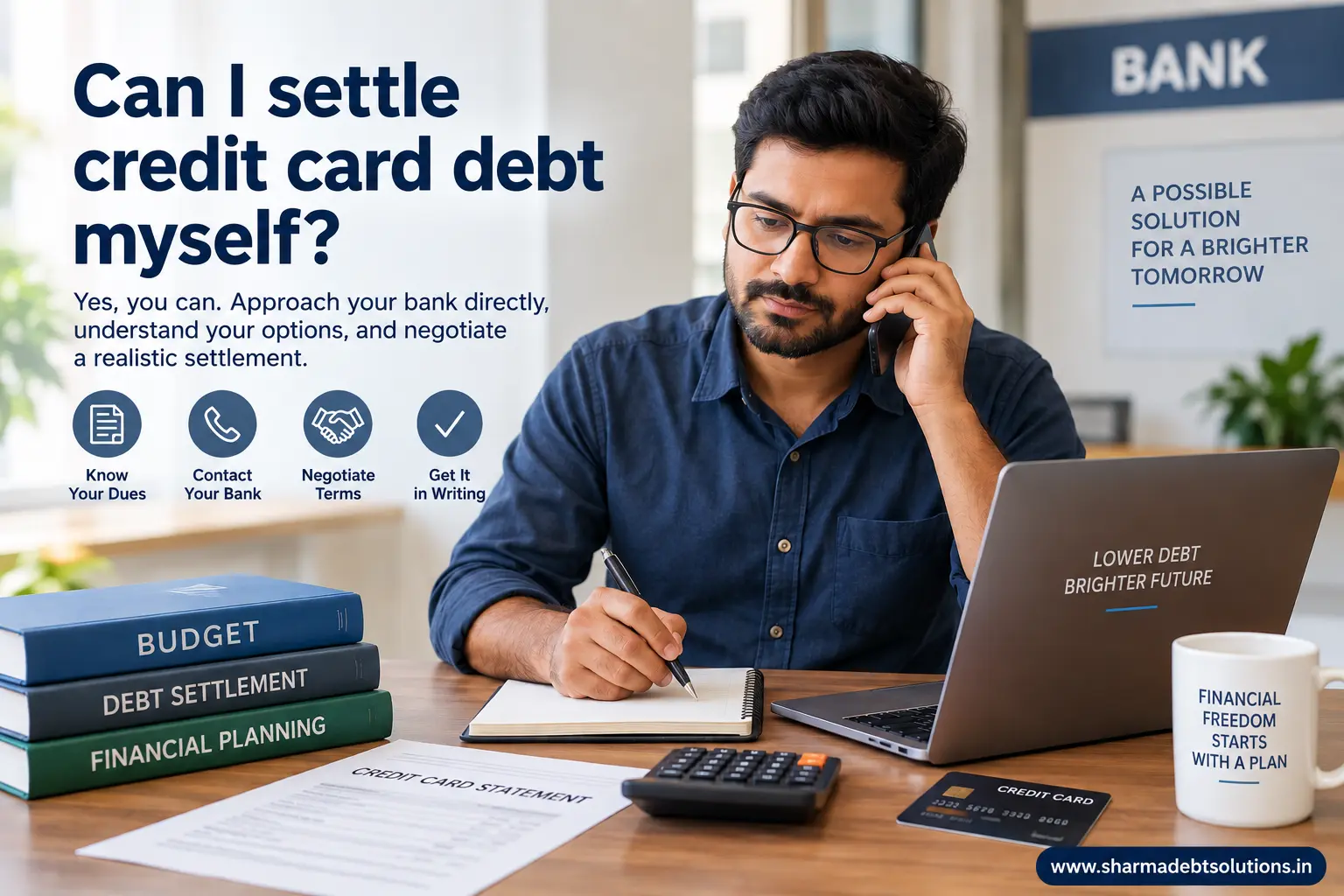
Yes, you can settle credit card debt yourself without hiring a debt settlement agency. A cardholder can approach the bank or credit card issuer directly, explain the financial difficulty, and ask whether a settlement can be considered.
If you are asking, can I settle credit card debt myself, the answer is yes, but the bank must agree to the proposed settlement. You do not need an agency simply to approach your bank and request a settlement.
If you want to understand the overall process, eligibility, negotiation, and possible outcomes, see our guide to credit card settlement in India.
However, doing it yourself does not mean the bank has to accept your offer. Credit card settlement is a negotiated arrangement, and the lender decides whether to accept the proposed settlement amount and on what terms.
If you are considering settling your credit card debt yourself, the important question is not simply whether you can negotiate. It is whether you can negotiate carefully, document the agreement properly, and understand the consequences before making the payment.
Can I Settle Credit Card Debt Myself Without an Agency?
You should also understand that a credit card settlement is a negotiated arrangement between you and the lender. The RBI framework on compromise settlements provides the regulatory framework for such settlements by regulated entities.
Yes. You can contact your credit card issuer directly and request a settlement.
Can I settle credit card debt myself without an agency? Yes, you can approach the credit card issuer directly and request a settlement. A debt settlement agency is not a mandatory requirement for making a settlement request.
A settlement generally involves the lender agreeing to accept an amount lower than the total outstanding dues as a full and final settlement of the account. The Reserve Bank of India recognises compromise settlements as negotiated arrangements. You can read the RBI framework on compromise settlements for the regulatory framework.
But there is an important distinction:
You can request a settlement yourself, but you cannot force the bank to settle your credit card debt.
The bank may:
- reject the settlement request;
- ask you to pay the full outstanding amount;
- offer a different settlement amount;
- ask you to provide financial information;
- offer another repayment or restructuring option; or
- agree to a settlement subject to specific terms and payment deadlines.
Therefore, if you decide to negotiate a credit card settlement without an agency, you should approach the process with realistic expectations.
How to Settle Credit Card Debt Yourself
If you want to negotiate a credit card settlement yourself, follow a structured process rather than simply calling the bank and asking for a discount.
If you are wondering can I settle credit card debt myself, start by understanding exactly how much you owe, what you can realistically afford, and whether settlement is actually the right option for your circumstances.
1. Understand exactly how much you owe
Before negotiating, collect your latest credit card statement and determine:
- total outstanding balance;
- overdue amount;
- interest and other charges;
- number of missed payments;
- account status;
- whether the account has been assigned to a recovery agency; and
- whether any legal or recovery proceedings have already started.
Do not negotiate based only on what a recovery caller tells you over the phone.
You need to know the actual outstanding amount and the status of the account before you decide how to proceed.
2. Assess whether settlement is actually appropriate
Credit card settlement is generally not the first option for someone who can comfortably repay the entire outstanding balance.
If you can repay your dues through normal repayment, an EMI arrangement, or another affordable option, you should compare those alternatives before choosing settlement.
Settlement can have a negative effect on your credit profile because the account may be reported as “settled” rather than “closed” when the lender accepts less than the full amount due.
So, before deciding can I settle credit card debt myself, consider not only whether you can arrange a settlement payment but also whether you understand the possible consequences.
The objective should not be:
“How can I get the biggest discount?”
The better question is:
“What is the most realistic way to resolve this debt given my financial situation?”
3. Decide what you can realistically afford
Before contacting the bank, calculate how much money you can actually arrange.
Do not promise an amount that you cannot pay within the settlement period.
For example, if you have ₹2 lakh outstanding but can realistically arrange only ₹70,000, you should understand your financial limit before entering negotiations.
Your ability to make a genuine payment can be an important part of the negotiation, but there is no guaranteed settlement percentage.
A settlement amount is ultimately determined through negotiation with the lender.
4. Contact the bank through an appropriate channel
Start with the credit card issuer rather than relying exclusively on a recovery agent.
Ask the issuer about the appropriate process for requesting a settlement or resolution of the overdue account.
Keep records of:
- emails;
- letters;
- settlement offers;
- payment instructions;
- names or identifiers of representatives; and
- important dates.
If a recovery agency is contacting you on behalf of the card issuer, remember that RBI directions require card issuers and their recovery agents to follow applicable recovery and fair-practice requirements. They must not resort to intimidation or harassment.
5. Make a realistic settlement proposal
If the bank is willing to consider settlement, you may be asked to make or respond to an offer.
Your proposal should be based on your actual financial capacity.
For example:
“I am currently unable to repay the entire outstanding amount due to financial hardship. I can arrange ₹X as a one-time payment if the bank is willing to accept it as full and final settlement of the account.”
Do not assume that the first amount suggested by either side will be the final settlement amount.
Negotiation may involve more than one discussion.
6. Get the settlement terms in writing
This is one of the most important steps when you settle credit card debt yourself.
Do not rely only on a telephone conversation.
Before making a settlement payment, carefully check the written settlement communication.
It should clearly identify the account and state:
- settlement amount;
- payment deadline;
- payment instructions;
- applicable conditions;
- treatment of the remaining outstanding amount; and
- what will happen after the agreed settlement amount is paid.
If you do not understand an important clause, ask the lender for clarification before paying.
7. Pay exactly according to the settlement terms
Once you accept the settlement terms, follow the payment instructions in the written communication.
Keep proof of every payment.
Do not transfer money to an unrelated individual simply because someone claiming to represent the bank asks you to do so.
Use the payment channel specified or verified by the lender.
8. Obtain confirmation after payment
After completing the settlement payment, obtain appropriate confirmation from the lender.
Depending on the lender’s process, this may include documentation confirming that the agreed settlement amount has been received and the account has been dealt with according to the settlement terms.
Keep the settlement letter, payment receipts, emails, and subsequent correspondence safely.
These documents can become extremely important if there is a later disagreement about the account.
Can I Negotiate Credit Card Settlement Directly With the Bank?
Yes.
You do not have to hire an agency merely to contact your bank and request a settlement.
If you are asking can I settle credit card debt myself, negotiating directly with the bank is one option when you are comfortable handling the process on your own.
However, negotiating directly does not guarantee a better settlement.
A bank may accept, reject, or modify your proposal depending on its internal policies, the account’s status, your payment history, the age of the overdue amount, and other circumstances.
The RBI’s compromise settlement framework requires regulated entities to maintain board-approved policies governing compromise settlements, including the process and permissible sacrifice for relevant exposures.
This means there is no universal rule such as:
“Every credit card company will settle for 40%.”
There isn’t.
Settlement outcomes vary from case to case.
What Should I Say When Asking for Credit Card Settlement?
Keep the request factual and professional.
You can say:
“I am currently facing financial difficulty and I am unable to clear the entire outstanding amount. I would like to request a settlement of the account and am willing to discuss a realistic one-time payment that I can arrange.”
You do not need to make exaggerated claims or threaten the bank.
The purpose of the negotiation is to find out whether the lender is willing to accept a settlement and, if so, under what terms.
Can I Settle Credit Card Debt Before Hiring a Settlement Agency?
Yes.
If you are financially capable of managing the negotiation yourself and are comfortable dealing directly with the lender, you may choose to do so.
A debt settlement agency or consultant is not a requirement for requesting a settlement.
Professional assistance can become useful when the situation is more complicated—for example, when there are multiple lenders, repeated recovery communications, documentation issues, disputes, or legal developments.
The important thing is to understand what you are paying for.
An agency cannot guarantee that a bank will accept a particular settlement percentage.
What Are the Disadvantages of Settling Credit Card Debt Yourself?
Doing it yourself can save professional fees, but you also take responsibility for managing the entire process.
Before deciding can I settle credit card debt myself, consider whether you are comfortable managing the negotiation, documentation and follow-up without professional assistance.
Potential difficulties include:
You may not know what to negotiate
A person dealing with debt for the first time may not know which terms require particular attention.
You may focus only on the settlement amount
The percentage reduction is not the only important issue.
The written settlement terms, payment deadline, account treatment, and subsequent reporting can also matter.
You may struggle with multiple lenders
Negotiating one credit card is very different from coordinating several credit cards, personal loans, consumer loans, and other liabilities.
Recovery activity can make the process stressful
If recovery agents are repeatedly contacting you, it can become difficult to have calm and organised negotiations.
RBI directions state that credit card issuers and their agents must not use intimidation or harassment in debt collection.
Legal action changes the situation
If a matter has already entered a formal legal process, do not assume that an ordinary telephone settlement discussion resolves everything.
The RBI’s compromise settlement framework states that where recovery proceedings have been commenced before a judicial forum and remain pending, a settlement is subject to obtaining a consent decree from the concerned judicial authority.
If you have received court papers or a formal legal notice, consider obtaining appropriate legal advice.
What Happens to CIBIL After Credit Card Settlement?
This is one of the biggest things to understand before deciding to settle your credit card debt.
If a lender accepts less than the full amount owed, the account may be reported as “settled” rather than “closed.”
CIBIL explains that a “settled” status indicates that the lender and borrower agreed on an amount lower than the amount originally payable. It can be viewed negatively by future lenders.
For credit cards, RBI’s directions also state that when a cardholder settles dues after being reported as a defaulter, the card issuer should update the status with the credit information company within 30 days of settlement.
Therefore, before settling, understand both sides of the decision:
Immediate benefit:
You may resolve an unaffordable debt for an agreed amount.
Potential long-term consequence:
The account may carry a “settled” status rather than showing as fully paid/closed.
Settlement should therefore be considered a financial resolution option—not a way to make a debt disappear without consequences.
For more information, see CIBIL’s explanation of the impact of a settled status on your CIBIL score.
Can I Settle Credit Card Debt Without Paying the Full Outstanding Amount?
That is the basic idea behind a compromise settlement.
A lender may agree to accept a negotiated amount that is lower than the total claim, subject to its applicable policy and approval process.
The RBI defines compromise settlement as a negotiated arrangement to fully settle the claims of the regulated entity in cash, potentially involving a waiver of part of the claim.
However, there is no guaranteed settlement percentage.
Do not base your decision on advertisements promising that every borrower can settle at a particular percentage.
Your actual outcome depends on the lender and the circumstances of your account.
Should I Settle My Credit Card Debt Myself or Use an Agency?
If you are asking can I settle credit card debt myself, the answer is yes. The more important question is whether doing it yourself is appropriate for your particular situation.
There is no universal answer.
Settling yourself may make sense if:
- you have one or two accounts;
- you are comfortable negotiating directly;
- you can understand the settlement documentation;
- you can arrange the required funds; and
- there is no complicated legal issue.
Professional assistance may be worth considering if:
- you have several lenders;
- you are struggling to manage multiple recovery calls;
- you are unsure how to approach negotiations;
- you need help organising settlement documentation;
- you have received legal notices; or
- you want structured guidance through the process.
The decision should be based on the complexity of your situation, not on the assumption that an agency can guarantee a particular settlement amount.
A Simple Checklist for Settling Credit Card Debt Yourself
Before making a settlement payment, make sure you have:
- Checked the actual outstanding amount.
- Understood your financial capacity.
- Confirmed who currently owns or services the account.
- Requested settlement terms in writing.
- Checked the settlement amount carefully.
- Checked the payment deadline.
- Confirmed how the remaining balance will be treated.
- Verified the payment instructions.
- Kept proof of payment.
- Obtained post-settlement confirmation.
- Understood the potential credit-reporting consequences.
Is Settling Credit Card Debt Yourself a Good Idea?
It can be.
If you have the ability to negotiate calmly, understand the documents, and deal directly with the lender, you can certainly settle credit card debt yourself.
But settlement should not be approached simply as a race to get the lowest possible number.
The real objective is to reach a documented agreement that you can actually fulfil and to understand what happens to the account and your credit history afterwards.
If the situation involves several lenders, persistent recovery activity, complicated documentation, or legal proceedings, professional guidance may make the process easier to manage.
Frequently Asked Questions
Can I settle credit card debt myself?
Yes. You can settle credit card debt yourself by approaching the credit card issuer directly and requesting a settlement. The lender is not required to accept your proposal, and the final terms depend on the lender’s applicable policies and the circumstances of the account.
Can I settle credit card debt without an agency?
Yes. A debt settlement agency is not mandatory. You can contact the lender yourself, negotiate the terms, obtain the agreement in writing, make the agreed payment, and retain the relevant documentation.
Can I negotiate credit card settlement directly with the bank?
Yes. You can request a settlement directly from the card issuer. The bank may accept, reject, or modify your proposal.
How much can I settle my credit card debt for?
There is no fixed percentage that applies to every borrower or every bank. Settlement amounts depend on the lender’s policies and the circumstances of the account. Be cautious of anyone promising a guaranteed settlement percentage.
Does credit card settlement affect CIBIL?
It can. When a lender accepts less than the full amount due, the account may be reported as “settled” rather than “closed.” This can negatively affect how future lenders view the account.
Can I settle my credit card debt before it becomes seriously overdue?
You can ask the lender about available resolution options at any stage, but the lender decides whether it will consider a settlement and on what terms. Do not assume that a particular number of missed payments automatically makes you eligible for settlement.
Should I stop paying my credit card to get a settlement?
Do not stop making payments simply because someone tells you that defaulting will guarantee a better settlement. Default can have serious financial and credit consequences. If you are considering settlement because you cannot afford the required payments, assess the alternatives and obtain appropriate guidance.
Can a bank refuse my credit card settlement request?
Yes. A bank can refuse a settlement request or propose different terms. A borrower cannot force a lender to accept a particular settlement amount.
Should I get a settlement letter before paying?
Yes. Obtain and carefully review the written settlement terms before making the settlement payment. Keep the settlement communication and proof of payment for your records.
What happens after I pay the settlement amount?
The lender should process the account according to the agreed settlement terms. Keep proof of payment and obtain appropriate confirmation from the lender. The account may be reported as “settled” rather than “closed” if less than the full amount was paid.
Can I settle credit card debt if a recovery agency is calling me?
You can discuss the account with the lender or its authorised recovery agent, but verify the authority and settlement terms. RBI requires card issuers and their recovery agents to follow applicable recovery practices and prohibits intimidation and harassment.
Do I need a lawyer to settle credit card debt?
Not necessarily. A straightforward settlement negotiation does not automatically require a lawyer. However, if you have received court documents, a formal legal proceeding is pending, or there is a dispute about the debt, legal advice may be appropriate.
Is credit card settlement better than repayment?
It depends on your financial circumstances. Full repayment generally avoids the consequences associated with settling for less than the amount due, but may not be realistic for someone facing severe financial difficulty. Settlement can provide a way to resolve an unaffordable debt, but it can have consequences for your credit history.
Final Takeaway
Can I settle credit card debt myself? Yes, you can.
You can approach the bank directly, request a settlement, negotiate the amount, obtain the terms in writing, make the agreed payment, and keep the necessary records.
But don’t confuse being able to negotiate yourself with being guaranteed a settlement.
The bank decides whether to accept the proposal. Before agreeing to settlement, you should understand the consequences, particularly the possibility that the account may be reported as “settled” rather than “closed.”
If your debt situation involves several lenders or has become difficult to manage, professional guidance may be worth considering. The important thing is to choose the approach that fits your financial situation rather than paying someone simply because you assume an agency is mandatory.