Managing money is hard. Managing multiple loans at the same time can feel impossible.
One EMI is due today. Another lender is calling tomorrow. Credit card bills keep piling up. Interest keeps growing silently in the background, like a leak you can’t see but definitely feel.
This is where a debt consolidation loan enters the conversation.
For many Indians, it sounds like a magic fix:
“One loan to close all loans. One EMI. Lower stress.”
But here’s the truth — a debt consolidation loan can either save you or sink you further, depending on how and when you use it.
This article breaks everything down clearly, honestly, and practically — without hype, without sales talk, and without complicated finance jargon.
If you’re dealing with multiple EMIs, overdue payments, or rising interest pressure, read this till the end. It could save you years of stress.
What Is a Debt Consolidation Loan?
A debt consolidation loan is a single loan taken to pay off multiple existing debts.
Instead of managing:
- Multiple EMIs
- Different interest rates
- Various due dates
- Constant follow-ups
You combine everything into one loan with one EMI.
The idea is simple:
- Fewer payments
- Better control
- Potentially lower interest
- Improved cash flow
But simplicity does not mean suitability for everyone.
How a Debt Consolidation Loan Works in India
Let’s break it down in real Indian terms.
Imagine this situation:
- Personal loan EMI
- Credit card outstanding
- Consumer durable loan
- Short-term app loan
Each has:
- Different interest rates
- Different repayment schedules
- Different penalties
A debt consolidation loan allows you to:
- Take a new loan
- Use that amount to close all existing loans
- Start fresh with one EMI
That’s it.
But what really matters is:
- Interest rate of the new loan
- Your current credit profile
- Whether consolidation reduces total cost or only delays pain
Types of Debt That Can Be Consolidated
A debt consolidation loan in India is usually used for unsecured debt, such as:
- Personal loans
- Credit card dues
- Buy-now-pay-later balances
- App-based instant loans
- Consumer finance loans
It is not meant for:
- Home loans
- Education loans
- Business loans (in most cases)
Trying to mix secured and unsecured debt usually creates more complications than benefits.
Who Should Consider a Debt Consolidation Loan?
A debt consolidation loan makes sense if:
- You have multiple high-interest loans
- Your EMIs are eating up most of your monthly income
- You’re still paying on time (or only slightly delayed)
- Your credit score is not badly damaged
- You want to simplify finances, not escape responsibility
In short, consolidation works best before things go out of control.
Who Should NOT Take a Debt Consolidation Loan
This part is often ignored — and that’s where people suffer.
A debt consolidation loan is not suitable if:
- You’re already in heavy default
- Your income is unstable or declining
- You’re facing legal notices or recovery pressure
- Your credit score is already severely impacted
- You’re thinking consolidation will “reduce” your debt magically
Consolidation does not erase debt.
It only restructures it.
If you’re already drowning, adding another loan may not be the lifeboat you need.
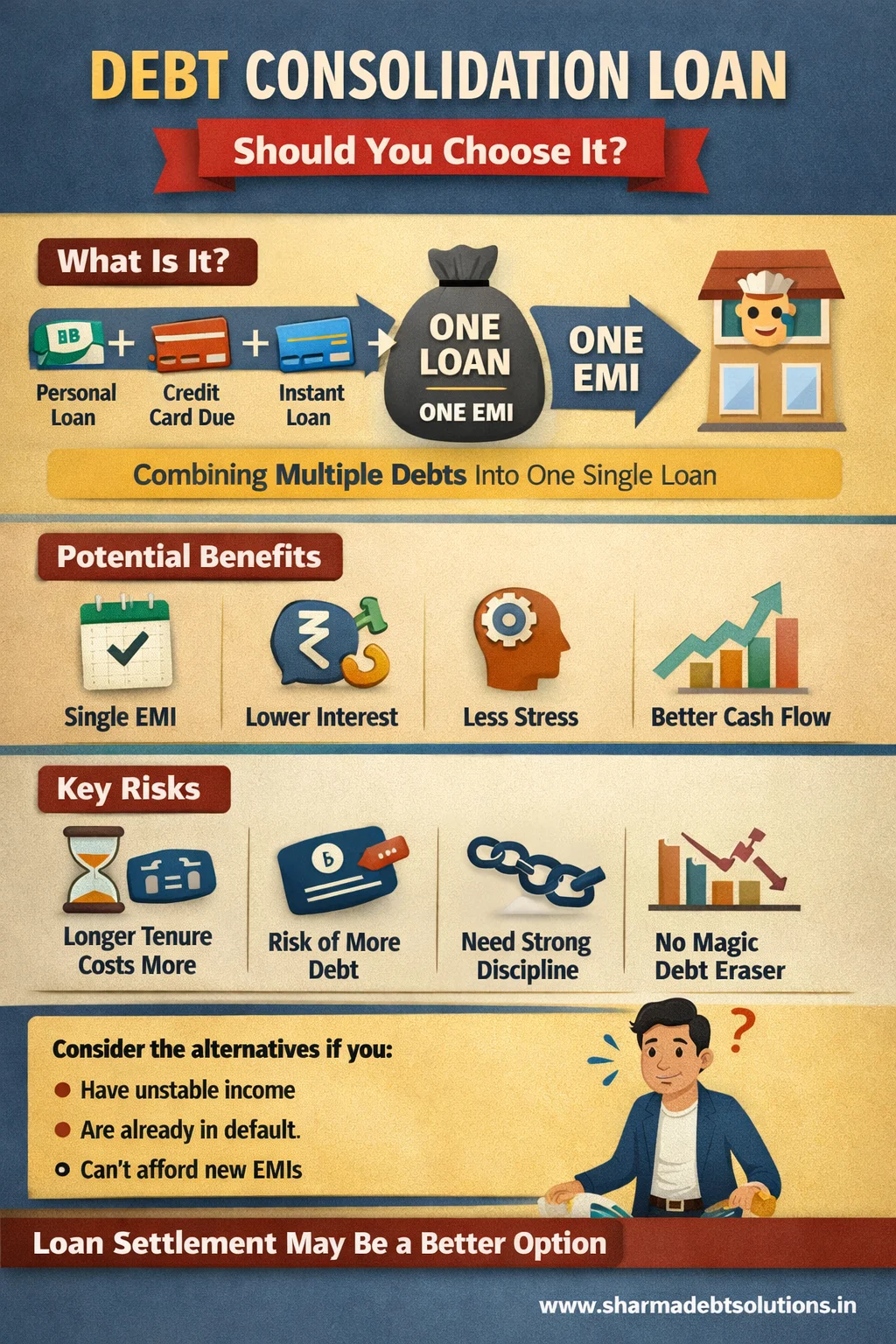
Visual guide to help you decide whether a debt consolidation loan is right for your situation.
Key takeaway: If you do not have sufficient funds or stable cash flow to manage a fresh EMI, a debt consolidation loan may not be the right solution. In such situations, exploring a structured loan settlement approach can be more practical than adding another loan to your burden.
Before making any decision, it’s important to understand your borrowing options carefully, including the long-term impact of taking a new loan versus restructuring existing liabilities.
Debt Consolidation Loan vs Debt Settlement: Know the Difference
This confusion ruins financial decisions.
Debt consolidation loan:
- You repay 100% of the loan
- Credit score impact is minimal if managed well
- Long-term structured repayment
- Requires decent eligibility
Debt settlement:
- You negotiate to pay less than total dues
- Credit score takes a hit
- Short-term damage, long-term relief
- Used in financial hardship situations
They are completely different tools for completely different stages.
Trying consolidation when settlement is needed is like using a bandage for a fracture.
Pros of a Debt Consolidation Loan
When used correctly, benefits are real:
- One EMI instead of many
- Easier tracking and planning
- Reduced mental stress
- Potential interest savings
- Better discipline and clarity
For salaried individuals with stable income, this can bring control back quickly.
Hidden Cons You Must Understand
Now the uncomfortable truths.
A debt consolidation loan can:
- Increase total repayment if tenure is extended
- Give a false sense of relief
- Encourage repeat borrowing
- Fail if spending habits don’t change
Many people consolidate today… and rack up fresh credit card debt tomorrow.
That’s not consolidation. That’s postponement.
Interest Rates: The Real Game Changer
Interest rate decides whether consolidation helps or hurts.
If:
- New loan interest is lower → good move
- Same or higher interest → pointless
- Longer tenure without savings → risky
Always calculate:
- Total interest paid earlier
- Total interest after consolidation
- EMI affordability vs total burden
If numbers don’t improve clearly, pause.
Debt Consolidation Loan Eligibility in India
Eligibility generally depends on:
- Income stability
- Employment type
- Credit score
- Existing liabilities
- EMI-to-income ratio
If your income is already stretched beyond comfort, approval becomes harder or costlier.
Common Mistakes With Debt Consolidation Loans
These mistakes are extremely common:
- Taking consolidation without closing old accounts properly
- Keeping credit cards active and overspending again
- Ignoring total repayment amount
- Believing consolidation improves credit automatically
- Taking advice from sales-driven sources
A debt consolidation loan is a strategy, not a shortcut.
How to Use a Debt Consolidation Loan Correctly
If you decide to go ahead, follow these rules strictly:
- Close old loans immediately
- Do not use credit cards unnecessarily
- Avoid fresh loans during repayment
- Build emergency savings alongside EMI
- Track spending monthly
Without discipline, consolidation fails.
Debt Consolidation Loan and Credit Score Impact
Used properly:
- Can stabilize credit score
- Improves payment history
- Reduces utilization stress
Used poorly:
- Can worsen score fast
- Increases risk of default
- Creates dependency on borrowing
Credit score improvement is a by-product, not a guarantee.
Is a Debt Consolidation Loan Right for You?
Ask yourself honestly:
- Can I afford the EMI comfortably?
- Will this reduce interest, not just stress?
- Am I ready to stop borrowing further?
- Is my income stable for the next few years?
If answers are unclear, pause and reassess.
Alternatives to a Debt Consolidation Loan
Sometimes consolidation is not the best option.
Alternatives include:
- Structured repayment planning
- Expense reduction strategies
- Negotiated repayment plans
- Partial prepayments
- Financial counselling
Choosing the right tool matters more than choosing the popular one.
Long-Term Mindset: The Real Solution
No loan fixes habits.
A debt consolidation loan only works if:
- Spending discipline improves
- Financial awareness increases
- Lifestyle inflation stops
- Emergency buffer is created
Without mindset change, consolidation becomes a revolving door.
Frequently Asked Questions
Can I take a debt consolidation loan with low credit score?
Possible, but costly and risky. Often not advisable.
Does debt consolidation loan reduce total debt?
No. It reorganizes it.
Is it better than paying separately?
Only if interest and structure improve clearly.
Final Verdict: Should You Take a Debt Consolidation Loan?
A debt consolidation loan is neither good nor bad on its own.
It is a tool.
Used at the right time, with the right numbers and discipline, it can:
- Restore control
- Reduce chaos
- Bring clarity
Used blindly, emotionally, or as an escape, it can:
- Deepen financial stress
- Delay the real problem
- Increase long-term cost
Before signing anything, slow down, calculate properly, and think long-term.
Money problems don’t need quick fixes.
They need clear thinking and smarter structure.
Conclusion
A debt consolidation loan can be a powerful financial reset — if used wisely.
For Indian borrowers juggling multiple EMIs, it offers simplicity, structure, and breathing space. But it is not a magic eraser. It demands responsibility, discipline, and honest self-assessment.
If you’re still early in your debt struggle, consolidation might help.
If you’re already overwhelmed, explore deeper solutions instead.
The smartest move is not choosing a loan.
The smartest move is choosing the right strategy.
And that decision alone can change your financial future.